 Sitwell
How to take a sitz bath for hemorrhoids
Key points
- Sit in 3-4 inches (about 8-10 cm) of plain warm water, about 40°C (104°F), so the skin around your bottom is covered.
- Stay in for 10-15 minutes, 2-3 times a day, and especially after a bowel movement when soreness is worst.
- Plain water is enough. There is no good evidence that Epsom salt, baking soda or oils help, and some additives can irritate the skin.
- Pat the area dry gently afterwards and never use water hot enough to sting: sitz baths have caused burns.
- Sitz baths ease discomfort for many people, but the research behind them is thin and they do not shrink or cure hemorrhoids.
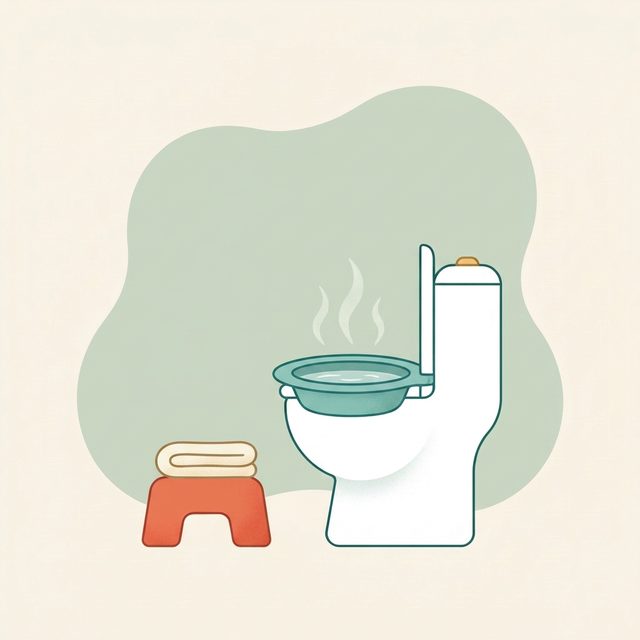
To take a sitz bath for hemorrhoids, sit your bottom in 3-4 inches (about 8-10 cm) of plain warm water, about 40°C (104°F), for 10-15 minutes, then gently pat the area dry (Cleveland Clinic, MedlinePlus). Do it two or three times a day while you have symptoms, especially after a bowel movement. You do not need to add anything to the water.
Hemorrhoids (spelled haemorrhoids in the UK, and often called piles) are swollen blood vessels in and around the back passage. A warm soak will not make them go away, but it can take the edge off pain, itching and soreness while the habits that actually help them settle do their work.
What a sitz bath is and how it helps
“Sitz” comes from the German word for “sit”. A sitz bath is a shallow, warm bath that covers only your hips and bottom.
Warm water seems to relax the internal anal sphincter, the ring of muscle that keeps the back passage closed. In a small 1993 study of healthy volunteers and people with hemorrhoids or anal fissures (small tears in the skin of the anus), pressure in the anal canal dropped while people sat in warm water and took 25 to 70 minutes to return to normal afterwards. Pain relief went along with that relaxation (Shafik 1993). That is a plausible reason people feel better.
Health services recommend warm soaks as part of home care. The NHS says to “take a warm bath to ease itching and pain” (NHS), and NIDDK suggests sitting in warm water several times a day to help relieve pain (NIDDK).
How to take a sitz bath for hemorrhoids: step by step
- Clean the basin or tub first. Wash and rinse it well before every use (Cleveland Clinic).
- Set it up. For a toilet kit, lift the seat, rest the basin on the toilet bowl as the kit’s instructions show, then lower the seat over it if your kit is designed that way. For a bathtub, put the plug in.
- Add warm water. Fill to 3-4 inches (about 8-10 cm), enough to cover the skin around your anus. Aim for about 40°C (104°F). If you have a bath thermometer, use it. If not, test with your wrist or the inside of your elbow: it should feel comfortably warm, never hot.
- Keep it plain. No soap, bubble bath, oils or salts (more on additives below).
- Sit down slowly and relax. Let your buttocks part a little so the water reaches the sore area.
- Soak for 10-15 minutes. A phone timer helps. If the water cools, top it up with warm water from the kit’s bag and tube or from a jug. In a bathtub, do not run the hot tap while you are sitting in it.
- Stand up slowly and step out carefully, especially from a bathtub.
- Pat dry. Use a clean, soft towel and pat, rather than rub (NHS).
- Empty and clean up. Pour the water away, rinse and clean the basin or tub, and let it dry. Keep a plastic basin for your own use only (Cleveland Clinic).
- Repeat two or three times a day while you have symptoms.
Many people find a sitz bath most useful straight after a bowel movement, when the area is sorest and needs gentle cleaning anyway.
Temperature, time and frequency at a glance
| What | Aim for | Why |
|---|---|---|
| Water temperature | Warm, about 40°C (104°F) | Comfortably warm relaxes the muscle; hot water can burn (Cleveland Clinic) |
| Water depth | 3-4 inches (about 8-10 cm) | Enough to cover the skin around the anus (Cleveland Clinic) |
| Time per soak | 10-15 minutes | MedlinePlus suggests 10-15; Cleveland Clinic says 15-20 |
| How often | 2-3 times a day, plus after a bowel movement if it helps | NIDDK says several times a day; Cleveland Clinic says up to 3-4 if they are helping |
| How many days | While symptoms last | Stop once the flare settles; see a doctor if it is getting worse or not improving |
How long to sit in a sitz bath
10 to 15 minutes is enough for most people (MedlinePlus). Cleveland Clinic suggests 15 to 20. There is no evidence that longer soaks work better, so keep it short and topped up with warm water.
How often to take a sitz bath
Two or three times a day is a sensible routine. NIDDK describes “several times a day” (NIDDK) and Cleveland Clinic says a provider may suggest three to four a day if they are bringing relief. More is not always better: if your skin starts to look red, puffy or more sore, cut back or stop.
How long you will need them depends on the type of hemorrhoid and how bad the flare is. Our guide on how long hemorrhoids last covers what to expect for each type.
Sitz bath on the toilet vs in the bathtub
Both work. MedlinePlus says a warm bath to relieve pain “could be a regular bath or a sitz bath” (MedlinePlus). Pick whichever is easiest for you to do several times a day.
| Bowl on the toilet | Bathtub | |
|---|---|---|
| Cost | A cheap plastic kit from a pharmacy or online | Free if you have a tub |
| Water needed | Very little | More, even for 3-4 inches |
| Speed | Quick to fill, empty and repeat | Slower to fill and clean |
| After a bowel movement | Very convenient, right where you are | Fine, but takes longer to set up |
| Getting in and out | Just sit on the toilet | Harder if you are sore, pregnant, just had surgery or have stiff joints |
| Keeping warm | Top up from the kit’s bag or a jug | Easier to keep the water warm |
| Cleaning | Rinse and wash the basin after each use | Clean the tub before and after |
| Sharing | Keep it for one person only | Clean well if others use the bath |
Sitz bath vs regular bath
The difference is mainly depth and convenience. A full, deep bath is not needed and is no better for hemorrhoids. If you do use a normal bath, keep the water shallow and plain, skip bubble bath and bath bombs, and keep the temperature warm rather than hot.
What to put in a sitz bath: what the evidence says
The short answer is plain warm water. Cleveland Clinic puts it directly: “You don’t need any Epsom salt for a sitz bath. Warm water alone works. Salts, oils and other substances may cause inflammation” (Cleveland Clinic).
Epsom salt
Epsom salt (magnesium sulfate) is the most popular addition. We searched the medical literature and could not find any good-quality study showing that it improves hemorrhoid symptoms compared with plain warm water. Any benefit is most likely from the warm water itself. If your doctor or midwife has told you to add salt, follow their advice.
Baking soda
Baking soda (sodium bicarbonate) is often suggested online for itching. We found no studies of baking soda sitz baths for hemorrhoids. There is no evidence it helps, so there is no reason to add it.
Soap, bubble bath and essential oils
Leave these out. Cleveland Clinic warns that salts, oils and other substances may cause inflammation (Cleveland Clinic). One NHS maternity leaflet allows a few drops of lavender oil or some sea salt after birth (Royal Berkshire NHS), but none of this has been shown to help hemorrhoids.
Witch hazel and medicated soaks
Witch hazel is usually used on pads or as a cream, not in a bath. The American Gastroenterological Association lists it among topical treatments that can be tried but notes there is little data that they work (AGA 2026). Doctors sometimes prescribe a medicated soak for specific problems. Only add a medicine to a sitz bath if a clinician has told you to.
Do sitz baths actually work?
Honestly, the evidence is thinner than the advice is common. A 2026 expert review from the American Gastroenterological Association says sitz baths are “often advised, but scientific data is limited” (AGA 2026). An earlier review of the literature found little scientific data to support them for anal problems (Tejirian and Abbas 2005), and a 2011 systematic review of four trials found no strong evidence that they reduce pain or speed healing, although patients were satisfied with them and no serious problems were reported (Lang 2011).
So why recommend them? They are cheap, low-risk, and many people say they feel better, which matters when you are sore. Just keep them in proportion. What helps hemorrhoids settle and stay away is soft stools, enough fibre and fluid, and not straining on the toilet. Guidelines from the American Society of Colon and Rectal Surgeons name these as the first-line treatment (ASCRS 2024).
Warm or cold?
Warm is the usual advice for pain and muscle spasm. Cold works better for swelling: older reports found cold sitz baths reduced swelling of the perineum more than warm ones, although people preferred the warm (Tejirian and Abbas 2005). The NHS suggests an ice pack wrapped in a towel to ease discomfort (NHS). You can use both: a cold pack for about 10 minutes when a lump is swollen, and warm soaks for comfort after the toilet. If you are not sure which type you have, see internal vs external hemorrhoids.
Staying safe
- Warm, not hot. Doctors have reported a burn around the anus from a hot-water sitz bath taken for hemorrhoids (Kahraman 2004), and skin burns appear among reported complications (Tejirian and Abbas 2005). Test the water with your wrist or elbow before you sit down. Do not go hotter than about 40°C (104°F) in the hope of more relief.
- Use plain water. Additives can irritate the skin (Cleveland Clinic).
- Keep it clean and personal. Clean the basin before and after each use and do not share it. Infections linked to sitz baths, including an outbreak among mothers and newborns, have been reported (Tejirian and Abbas 2005).
- Pat dry, do not rub. Use a clean, soft towel (NHS).
- Stop if things get worse. If pain increases or the skin turns red and puffy, stop and speak to a doctor (Cleveland Clinic).
- Take care getting up. Stand slowly, and hold on to something when stepping out of a bath.
Sitz bath after hemorrhoid surgery
Warm sitz baths are routinely recommended after anal surgery (Gupta 2008). Your surgeon’s instructions come first: follow what they tell you about when to start, how often to soak, and how to look after the wound.
The research is mixed. In a trial of 50 people after hemorrhoid removal, twice-daily sitz baths did not lower pain or painkiller use (Gupta 2008). In a 2024 trial of 64 people, starting warm sitz baths 6 hours after surgery instead of the next day led to slightly lower wound pain (Liao 2024). And in a 2025 trial of 166 people, ice packs gave lower pain in the first 16 hours, less swelling and less need for strong painkillers than warm sitz baths (Chen 2025).
The practical takeaway: sitz baths after surgery are safe and comforting for many people, but they are not essential, and cold may help more in the first day. Keep the water plain and the basin very clean while the wound heals, and call your surgical team about heavy bleeding, fever or worsening pain.
Sitz bath after giving birth
Hemorrhoids affect up to two-thirds of women during pregnancy (AGA 2026), and a sore perineum (the area between the vagina and the anus) is common after birth. Sitz baths are widely used for both.
If you are pregnant or have recently had a baby, Cleveland Clinic advises checking with your midwife or doctor before starting sitz baths (Cleveland Clinic). One NHS hospital’s maternity leaflet, for example, suggests a shallow bath of about 4 inches after the first 24 hours, using plain water with no soap or bubble bath (Royal Berkshire NHS).
Cold can be worth trying here too. In a small, older study of 40 women with stitches after an episiotomy (a cut made during birth), cold sitz baths relieved perineal pain more than warm ones (Ramler and Roberts 1986). The NHS also suggests holding a cloth wrung out in iced water gently against hemorrhoids in pregnancy, and patting rather than rubbing after the toilet (NHS).
For more on this stage of life, see hemorrhoids during pregnancy and after birth.
Making sitz baths part of a routine
Sitz baths are easier to keep up when tied to something you already do, such as after your morning bowel movement and before bed. Pair them with the basics that treat the cause: plenty of fibre and fluids, going when you feel the urge, and not straining or sitting on the toilet for long (NHS). The Sitwell app lets you tick off these habits each day and see how your symptoms change.
When to see a doctor
A sitz bath is for comfort. It should not delay getting checked when something is not right.
Get medical help today (emergency department, urgent care, or your local emergency number) if you have:
- Heavy bleeding that does not stop, or you are passing blood clots
- Bleeding along with feeling faint, dizzy or short of breath
- Severe pain with a fever, or a lump that is quickly getting bigger, darker or harder
Book a doctor’s appointment in the next few days if you have:
- Black or tar-like stools, or dark blood mixed into the stool
- Weight loss without trying, or unusual tiredness
- A change in bowel habit lasting more than 3 weeks (looser, more often, or new constipation)
- Bleeding that no doctor has examined, and you are over 45 or have bowel cancer in the family
The NHS also advises an urgent appointment if you feel hot, cold or shivery and generally unwell, have painless bleeding from the bottom, or pus is coming from the area, and a routine GP visit if your symptoms are getting worse or not improving with home treatment (NHS). Cleveland Clinic suggests calling a provider if your pain has not started to improve after two or three sitz baths (Cleveland Clinic).
If a sudden, hard, very painful lump has appeared at the edge of your anus, see a doctor within a few days. Some people with this kind of clotted (thrombosed) hemorrhoid benefit from having it removed early (ASCRS 2024). Our guide on bleeding hemorrhoids and when to see a doctor goes through the warning signs in more detail.
Frequently asked questions
How long should I sit in a sitz bath for hemorrhoids?
10 to 15 minutes is a good default, and it is what MedlinePlus suggests. Cleveland Clinic gives a range of 15 to 20 minutes. Sitting much longer is not known to help more, and the water cools down, so top it up with warm water if you stay in past 10 minutes.
How often should I take a sitz bath?
Two or three times a day is typical, and many people add one after each bowel movement. NIDDK describes sitting in warm water several times a day, and Cleveland Clinic says a provider may suggest three to four a day if they are helping. Keep going while you have symptoms and stop once the flare settles.
Should I put Epsom salt in a sitz bath?
You do not need to. Cleveland Clinic says warm water alone works and that salts, oils and other substances may cause inflammation. We could not find any good studies showing that Epsom salt adds anything for hemorrhoids, so only add it if your doctor or midwife has told you to.
Is a sitz bath better than a regular bath?
Not that anyone has shown. MedlinePlus says either a regular warm bath or a sitz bath can help relieve pain. A sitz bowl on the toilet is quicker, uses less water and is easier after a bowel movement, while a bathtub works fine if getting in and out is easy for you.
Can I take a sitz bath after hemorrhoid surgery?
Usually yes, and surgeons often recommend them, but follow your own surgeon's instructions on when to start and how often. Trials disagree on how much they help with pain after surgery, and one trial found ice packs worked better than warm sitz baths in the first day.
Can I use a sitz bath after giving birth?
NHS maternity leaflets, such as Royal Berkshire's, suggest a shallow, plain-water bath after the first day, and sitz baths are widely used for soreness after birth. Cleveland Clinic advises asking your midwife or doctor first if you are pregnant or have recently had a baby.
Do sitz baths shrink hemorrhoids?
There is no evidence that they do. Warm water seems to relax the muscle ring around the anus, which can ease pain and spasm, but it does not remove the swollen blood vessels. Soft stools and not straining are what help hemorrhoids settle.
Sources
- Piles (haemorrhoids). NHS
- Piles in pregnancy. NHS
- Treatment of Hemorrhoids. NIDDK (US National Institutes of Health)
- Sitz Bath. Cleveland Clinic
- Hemorrhoids. MedlinePlus (US National Library of Medicine)
- Hemorrhoids (medical encyclopedia). MedlinePlus (US National Library of Medicine)
- The American Society of Colon and Rectal Surgeons Clinical Practice Guidelines for the Management of Hemorrhoids. Hawkins and others. Diseases of the Colon & Rectum, 2024
- AGA Clinical Practice Update on Diagnosis and Treatment of Hemorrhoids: Expert Review. Qureshi and others. Clinical Gastroenterology and Hepatology, 2026
- Sitz bath: where is the evidence? Scientific basis of a common practice. Tejirian and Abbas. Diseases of the Colon & Rectum, 2005
- Effectiveness of the Sitz bath in managing adult patients with anorectal disorders. Lang and others. Japan Journal of Nursing Science, 2011
- Role of warm-water bath in anorectal conditions. The "thermosphincteric reflex". Shafik. Journal of Clinical Gastroenterology, 1993
- Warm sitz bath does not reduce symptoms in posthaemorrhoidectomy period: a randomized, controlled study. Gupta. ANZ Journal of Surgery, 2008
- Effects of early warm water sitz bath on urinary retention and pain after haemorrhoidectomy: a randomized controlled trial. Liao and others. International Journal of Nursing Studies, 2024
- Ice Packing Versus Warm Sitz Baths for Post-hemorrhoidectomy Pain Management: A Randomized Controlled Trial. Chen and others. Diseases of the Colon & Rectum, 2025
- Perianal burn as a complication of hemorrhoid treatment caused by hot water sitz bath. Kahraman and others. Burns, 2004
- A comparison of cold and warm sitz baths for relief of postpartum perineal pain. Ramler and Roberts. Journal of Obstetric, Gynecologic & Neonatal Nursing, 1986
- Tears and stitches (patient leaflet). Royal Berkshire NHS Foundation Trust, 2024
This guide is general information, not medical advice. If you have heavy bleeding, severe pain, a fever or feel faint, get medical help now.